
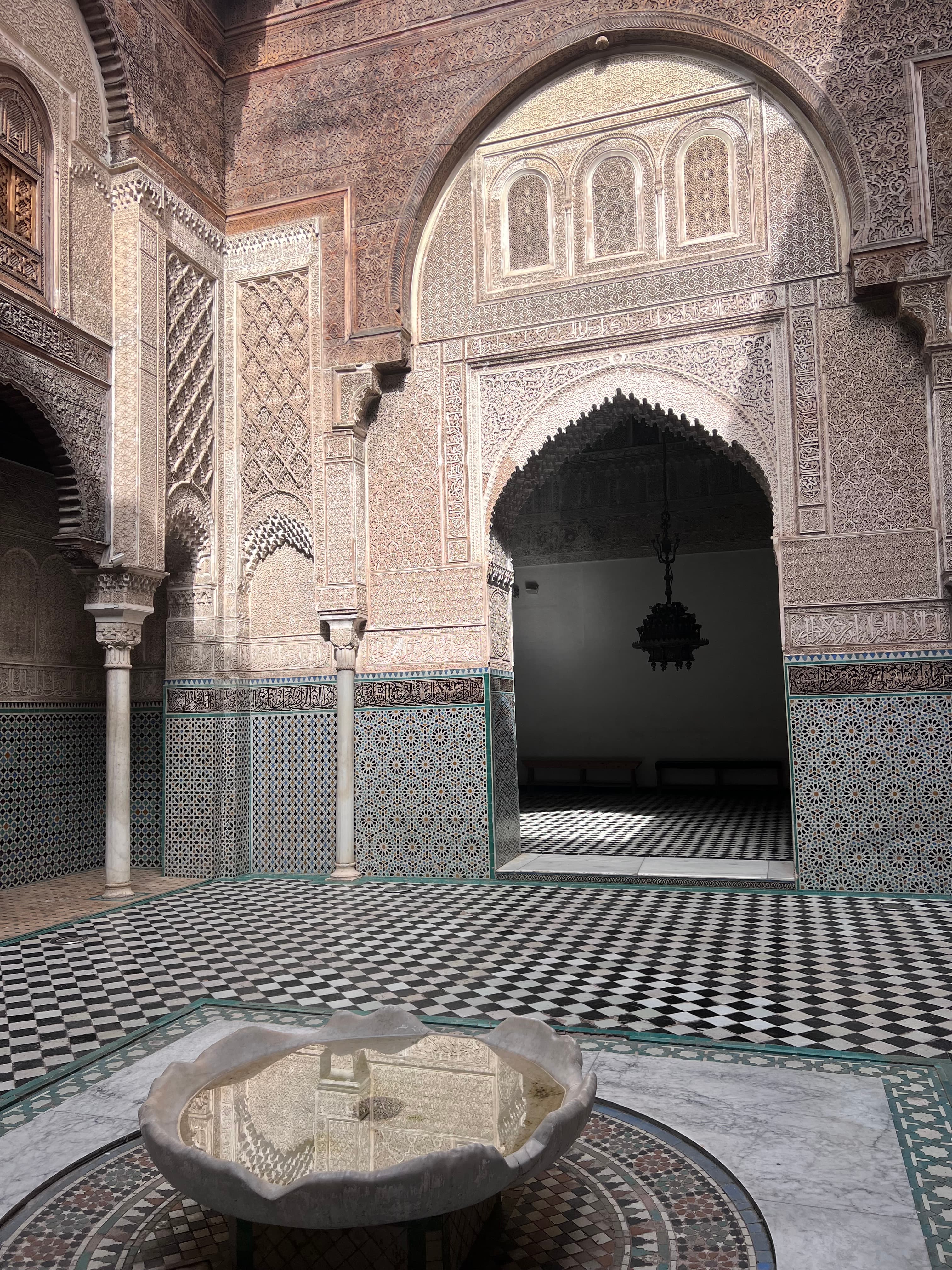
The Funduq Al-Najjarin — the Carpenters' Inn — is one of the most beautiful buildings in Fez el Bali and a masterpiece of 18th-century Moroccan architecture. Built in 1711, it served for centuries as a commercial inn and warehouse for merchants visiting the city. Today, after meticulous restoration, it houses the Wood Arts Museum.
Architecture
The funduq is built around an open central courtyard in the classic caravanserai style — a space of extraordinary beauty. Three storeys of carved cedar balconies rise above a floor of intricate zellige tilework, with a central fountain that has gurgled continuously for three centuries. The carved stucco and cedarwood decoration throughout the building represents some of the finest craftsmanship in Morocco.
The Wood Arts Museum
The museum's collection showcases the extraordinary tradition of Moroccan woodworking — carved cedar screens, decorative panels, instruments, furniture, and architectural elements spanning several centuries. The displays illustrate how the mashrabiya (carved wooden lattice screen), the carved cedar ceiling, and the ornate wooden door have been central to Moroccan domestic architecture since the medieval period.
Place en-Nejjarine
The funduq opens onto the Place en-Nejjarine — one of the medina's most beautiful squares, lined with craftsmen's workshops and dominated by an ornate 18th-century fountain. Carpenters still work in the lanes around the square, continuing a tradition that has existed here for seven hundred years.
Location and Visiting
The Funduq Al-Najjarin is located in the heart of Fez el Bali, a short walk from the Kairaouine Mosque. Entry to the museum requires a small admission fee; the view from the upper galleries across the courtyard and over the medina rooftops is alone worth the visit.